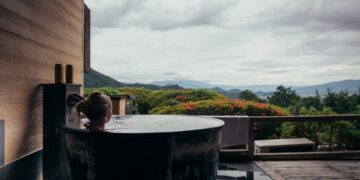
Tokyo onsen carry a quiet philosophy that France understands well: the belief that daily beauty and bodily care are not luxuries but essentials, and that a city life lived without ritual is a life half-felt.
The art of the after-dark soak
Tokyo’s bathing culture is urban and practical. It lives in the post-work soak at a neighborhood sento, in a weekend morning at a natural spring facility, in a late-night wind-down at a hotel onsen. This is not spa tourism. It is something older and more honest.
Communal baths, segregated by gender, played an important role in daily health and hygiene in Tokyo during the post-war years, when many cramped dwellings had no bathing facilities. Sento also served as community hubs for social interaction, a place to catch up with friends and neighbors.
Many locals, from salarymen to seniors, treat a nightly hot soak as therapy for body and soul. To step into this habit is to step into Tokyo as it truly lives.
1. Thermae-Yu, Shinjuku
For those looking for a genuine late-night soak, Thermae-Yu in Shinjuku’s Kabukicho district is hard to beat. It offers a high-end spa experience and stays open through the night. The building sits where neon meets calm, a contrast that feels entirely Tokyo.
Inside, multiple baths draw on different mineral profiles. The space is clean, modern, and designed for long stays. If you stay past midnight, an additional late-night fee applies. Plan ahead and treat it as your evening destination, not just a quick stop.

2. Daikoku-yu, Katsushika
Daikoku-yu offers multiple open-air baths, saunas, and relaxation areas with full views of Tokyo Skytree. It has a friendly, neighborhood atmosphere and stays open well past midnight.
This sento sits in Katsushika, a working district far from the tourist map. That is exactly its appeal. You might hear neighborhood gossip and could even make friends with the locals while you are there. The outdoor bath under the open sky is the clear highlight after a long week.
3. Kosugi-yu, Koenji
Koenji has long been one of Tokyo’s most individual neighborhoods, full of vintage shops, jazz bars, and quiet side streets. Whether you are ending your day or about to explore the nightlife in Koenji, Kosugi-yu is a great place to take a pause and freshen up.
The interior of Kosugi-yu is designed with care. Art installations line the walls, and the bathing area balances a retro tile aesthetic with contemporary renovation. Sento have long been woven into the fabric of daily life. Recently, they have been quietly revitalizing across Tokyo, modernizing facilities to welcome younger bathers and international visitors while preserving their retro charm.
Expert perspective on Tokyo onsen and bathing culture
Tokyo’s public bathhouses carry a kind of knowledge that cannot be found in any guidebook. The ritual of washing before entering the water, of moving slowly between warm and cool baths, of sitting in silence with strangers: this sequence has real physiological value. Thermal bathing opens blood vessels and supports circulation. The minerals in natural spring water interact with the skin and the nervous system. But beyond the physical, the sento teaches something important about time. It asks you to stop. In a city that moves at the speed Tokyo moves, that instruction is almost radical. The bathhouse is where the city goes to remember that the body comes first.
Industry perspective, well-being and thermal bathing professionals in Tokyo




4. Shimizu-yu, Minami Aoyama
Shimizu-yu sits in the upmarket Omotesando-Aoyama district, a short walk from Omotesando Station. It opens at noon and stays open until midnight on weekdays. The address alone surprises people. A neighborhood sento in one of Tokyo’s most design-conscious districts feels like a quiet secret.
There are a number of baths and background music to create a relaxing atmosphere. Large and small towels are available for rent, and simple amenity kits can be purchased at the counter. The atmosphere is calm and unhurried, exactly what Aoyama asks of its evenings.
5. Toyosu Manyo Club, Toyosu
Tokyo Toyosu Manyo Club opened in 2024 and offers a unique take on the traditional super sento experience in the Toyosu area of Koto district. The facility is part of a larger complex inspired by Edo-period Tokyo.
It is not just a bathhouse. It uses natural hot spring water transported daily from Hakone Yumoto and Yugawara by tanker. Reviewers highlight the stunning architecture, large bath areas, rooftop outdoor bath, and relaxing atmosphere. The rooftop bath with views of Tokyo Bay after dark is one of the city’s great evening experiences.
6. Musashi Koyama Onsen Shimizuyu, Shinagawa
Musashi Koyama Onsen Shimizuyu in Shinagawa draws dark Kuroyu mineral water from 200 meters underground. The water is genuinely therapeutic and the experience is woven into city routines rather than framed as destination travel.

The dark water is striking on first sight. It is rich in organic minerals, and the color signals the depth from which it comes. This is a true Tokyo onsen in the oldest sense, a place where the earth offers something to the body and the city steps back to let it happen. Bring a small towel, arrive after 8 PM on a weeknight, and stay as long as you need.
Why Tokyo onsen after dark deserve your full attention
For Japanese people, bathing is more than a way to cleanse the body. It is a longstanding cultural practice connected to both physical and spiritual purification. That intention is still present in every bathhouse on this list.
A Tokyo onsen after dark offers something rare in a dense city: stillness, warmth, and a moment that belongs entirely to you. The adult entry fee at a standard sento is 550 yen as of mid-2025. For this price, bathers enjoy steamy tubs, showers, and often saunas, offering a wellness experience at a fraction of a spa’s cost. Visit once and you will understand why Tokyoites return every week without question.
Discover more about Tokyo onsen
- Soaking in Tokyo’s Rich Sento Culture (Tokyo Metropolitan Government)
- Public Baths in Tokyo: Sento, Onsen, Etiquette and Tips (E-Housing 2026 Guide)
- Tokyo’s Sento Are Opening Their Arms to Foreign Tourists (Unseen Japan, September 2025)